If you’re preparing for CSRD, you will quickly come across one of the most important concepts in sustainability reporting: Scope 1, Scope 2, and Scope 3 emissions.
At first glance, these terms can feel abstract. In practice, they simply describe where your company’s emissions are coming from.
Understanding this properly is critical, because CSRD — especially under ESRS E1 — requires companies to measure and report these emissions.
Let’s break it down in a simple and practical way.
What are Scope 1 emissions?
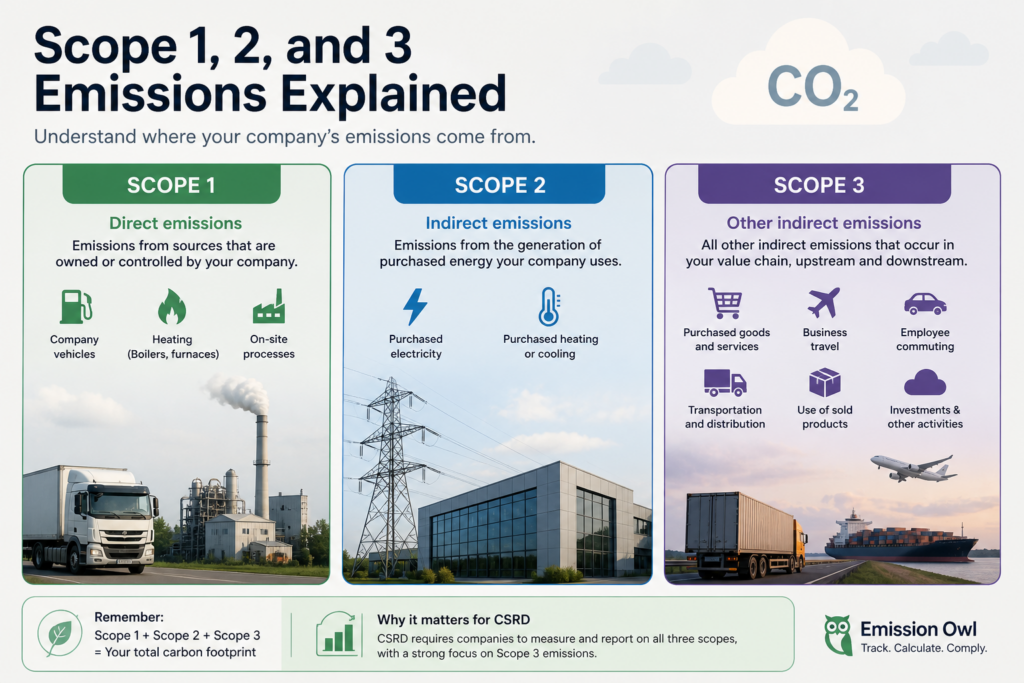
Scope 1 emissions are direct emissions that come from sources your company owns or controls.
These are usually the easiest to understand because they happen inside your operations.
Examples include:
- Fuel burned in company vehicles
- Gas used for heating your office or facility
- Emissions from machinery or generators you operate
If your company is directly responsible for the source, it’s Scope 1.
What are Scope 2 emissions?
Scope 2 emissions are indirect emissions from the energy your company purchases.
Even though the emissions don’t happen on your premises, they are still caused by your energy consumption.
The most common example is electricity.
When your office uses electricity, the emissions happen at the power plant — but they are attributed to your company’s usage.
Heating or cooling purchased from external providers can also fall into Scope 2.
What are Scope 3 emissions?
Scope 3 emissions are everything else. This is where things become more complex.
Scope 3 includes indirect emissions across your value chain — both upstream and downstream.
In simple terms, it covers emissions that happen because of your business, but not directly from your operations or purchased energy.
Examples include:
- Employee commuting
- Business travel, such as flights and hotels
- Production of goods or materials your company purchases
- Transportation and distribution by third parties
- Use of your products by customers
- Cloud services and software infrastructure
For most companies, Scope 3 is by far the largest and most difficult category to track.
This is also where many companies struggle the most when preparing for CSRD.
A simple way to remember the three scopes
A useful way to think about the three scopes is:
- Scope 1: what your company burns or produces directly
- Scope 2: the energy your company buys
- Scope 3: everything else connected to your business
In reality, companies often start with Scope 1 and Scope 2 because the data is easier to access.
However, CSRD puts strong emphasis on Scope 3, which requires data from suppliers, partners, and external systems.
This creates challenges such as incomplete data, inconsistent formats, and difficulty choosing the right emission factors.
Why activity data is not enough
Another key point is that emissions are not reported as raw activity data.
You don’t just report “liters of fuel” or “kWh of electricity.”
You need to convert activity data into CO₂ equivalent emissions using standardized emission factors.
This is where many teams run into complexity, especially when trying to do this manually in spreadsheets.
How to get started
A practical approach to get started is:
- Map your activities into categories like energy, transport, and purchased goods
- Collect basic activity data such as fuel usage, electricity consumption, and travel distance
- Apply emission factors to calculate CO₂ impact
- Group the results into Scope 1, 2, and 3
This sounds manageable, but as soon as you scale across departments or locations, it quickly becomes difficult to maintain.
That’s why many companies move away from manual tracking and look for more structured solutions.
Final thoughts
Understanding Scope 1, 2, and 3 is not just a theoretical requirement.
It is the foundation of your entire sustainability reporting process.
If this part is unclear or incomplete, everything else — including ESRS reporting and audits — becomes much harder.
The key is to centralize your data, standardize calculations, and avoid fragmented tracking across tools.
Instead of trying to manage everything manually, you can track, calculate, and organize your emissions in one place.
Start tracking your Scope 1, 2, and 3 emissions with Emission Owl and build a solid foundation for CSRD compliance.