If your company falls under CSRD, the biggest question is not what it is — but how to actually prepare for it.
Many companies underestimate this part.
CSRD is not just about writing a report at the end of the year. It requires structured data, consistent processes, and alignment with ESRS standards across your organization.
The good news is that you can break it down into clear and manageable steps.
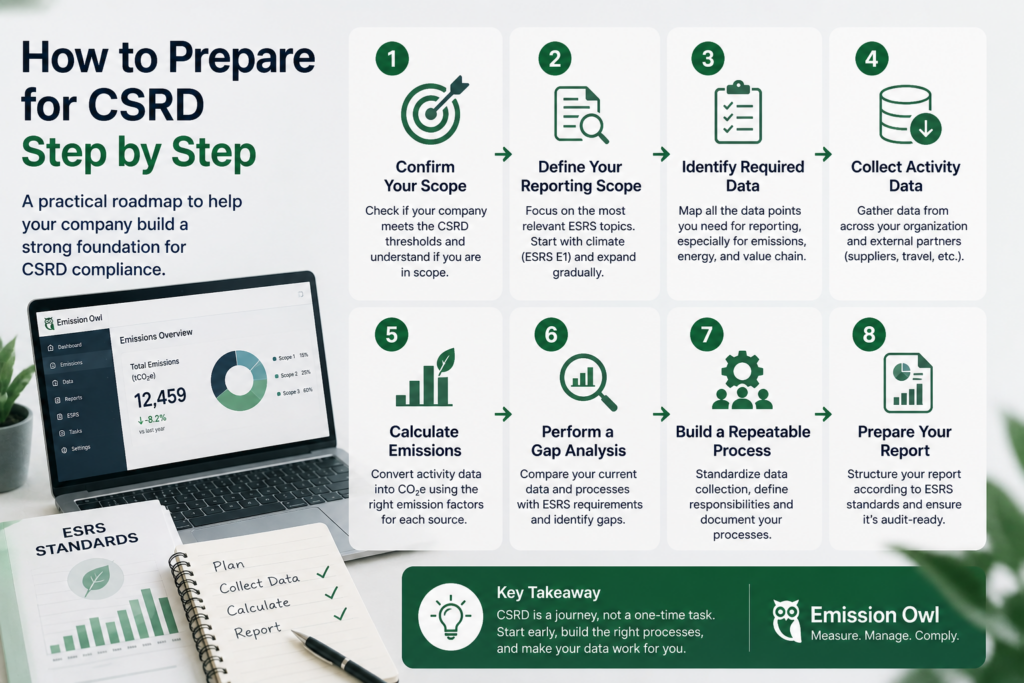
Here is a practical, step-by-step approach you can follow.
1. Confirm whether your company is in scope
Before doing anything else, make sure CSRD actually applies to you.
Check your company size, revenue, and assets against the thresholds. If you are close to the limits, it is still wise to prepare early.
Even if you are not required yet, you likely will be soon.
2. Define your reporting scope
CSRD is based on ESRS standards, which cover multiple areas such as climate, water, pollution, and governance.
You do not need to do everything at once.
Start by focusing on the most relevant area for most companies, which is climate under ESRS E1.
This includes emissions, energy usage, and transition planning.
Starting focused will help you move faster and avoid being overwhelmed.
3. Identify required data
Once you know your scope, the next step is to understand what data you need.
For climate reporting, this typically includes:
- Energy consumption such as electricity and gas
- Fuel usage for vehicles or operations
- Transport and logistics data
- Business travel
- Purchased goods and services
At this stage, you are not collecting data yet — you are mapping what is required.
4. Collect activity data
Now you begin gathering actual data from across your organization.
This often involves multiple teams such as finance, operations, HR, and procurement.
Examples include:
- Electricity bills
- Fuel invoices
- Travel records
- Supplier data
This step is usually more difficult than expected, especially when data is spread across systems or departments.
5. Calculate emissions
Raw data alone is not enough.
You need to convert activity data into CO₂ emissions using emission factors.
For example:
- Electricity consumption is converted using grid emission factors
- Fuel usage is converted based on fuel type
- Travel is converted based on distance and transport method
This step introduces technical complexity and is where many companies struggle if they rely only on spreadsheets.
6. Perform a gap analysis
Once you have initial data and calculations, you need to identify what is missing.
This is called a gap analysis.
You compare what you currently have against what ESRS requires.
Typical gaps include:
- Missing Scope 3 categories
- Incomplete supplier data
- Inconsistent formats
- Lack of documentation for audits
This step is critical because it shows how far you are from being compliant.
7. Build a repeatable process
CSRD is not a one-time task.
You will need to report every year, and your data must be consistent and auditable.
That means you need processes, not just data.
- Define who is responsible for each data source
- Standardize how data is collected
- Ensure calculations are consistent
- Document everything clearly
Companies that skip this step often struggle in the second year.
8. Prepare your report
Once your data is structured and gaps are addressed, you can prepare your CSRD report.
This includes aligning your data with ESRS formats and ensuring it is ready for audit.
At this stage, the quality of your earlier steps will determine how easy or difficult reporting becomes.
Why most companies struggle
Even though the steps are clear, companies run into problems because:
- Data is scattered across systems
- Manual processes do not scale
- Scope 3 is difficult to track
- Requirements are complex and evolving
This is why many teams start with spreadsheets and quickly outgrow them.
Final thoughts
Preparing for CSRD is not about doing everything perfectly from day one.
It is about building a structured approach and improving over time.
If you start early, focus on the right scope, and build proper processes, compliance becomes manageable.
If you wait until reporting deadlines are close, it becomes stressful and error-prone.
The smartest approach is to centralize your data, automate calculations, and make your reporting process repeatable.
Instead of managing everything manually, you can streamline your entire CSRD workflow in one place.
Start preparing for CSRD with Emission Owl and turn a complex process into a structured system.