If you’re running a company in Europe, you’ve probably heard about CSRD—but what does it actually mean, and should you care in 2026?
The short answer: yes, probably.
The longer answer is what we’ll break down here.
What is CSRD?
The Corporate Sustainability Reporting Directive (CSRD) is a European regulation that requires companies to report on their environmental and social impact.
It replaces and expands the older Non-Financial Reporting Directive (NFRD) and significantly increases both:
- the number of companies that must report
- and the level of detail required
In simple terms, CSRD means:
Companies must report not only financial performance—but also their impact on the environment and society.
Why Was CSRD Introduced?
CSRD exists because sustainability reporting used to be:
- inconsistent
- incomplete
- and often unreliable
The EU introduced CSRD to:
- standardize reporting across companies
- improve transparency for investors
- support climate goals (like net-zero targets)
What Do Companies Need to Report?
Under CSRD, companies must follow a framework called ESRS (European Sustainability Reporting Standards).
These include areas like:
- Climate change (emissions, energy use)
- Pollution
- Water usage
- Biodiversity
- Circular economy
The most important one for most companies is:
👉 Climate (ESRS E1) — which includes:
- Scope 1, 2, and 3 emissions
- Energy consumption
- Transition plans
What is Double Materiality?
One of the biggest changes in CSRD is something called double materiality.
Companies must assess:
- Impact materiality
→ How your company affects the environment - Financial materiality
→ How environmental issues affect your business
Both perspectives are required—not optional.
Does CSRD Apply to Your Company in 2026?
This is where things get important.
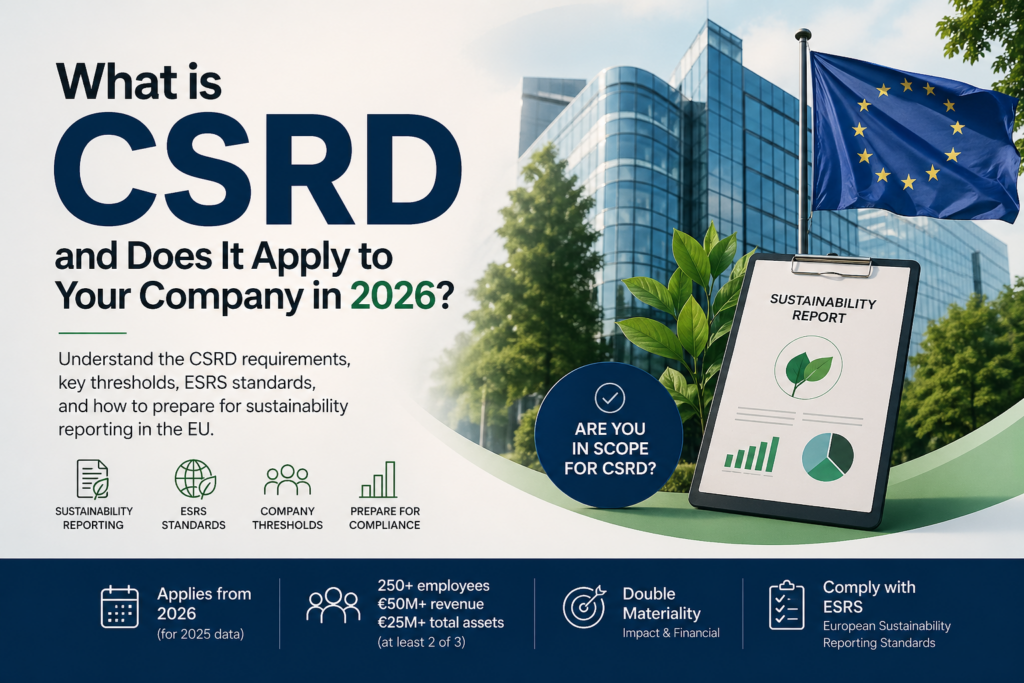
Starting in 2026 (for 2025 data), CSRD applies to many more companies than before.
You are likely in scope if your company meets at least 2 of the following:
- 250+ employees
- €50M+ revenue
- €25M+ total assets
It also applies to:
- EU-listed SMEs (with some delay options)
- Non-EU companies with significant EU operations
👉 In practice, this means tens of thousands of companies must now comply.
Why CSRD Is Hard in Practice
On paper, CSRD sounds straightforward.
In reality, companies struggle with:
- Collecting data from multiple sources
- Calculating emissions (especially Scope 3)
- Mapping data to ESRS requirements
- Performing gap analysis
- Keeping everything audit-ready
Most teams start with spreadsheets—and quickly hit limitations.
How to Prepare for CSRD
A practical way to approach CSRD is:
- Identify if you’re in scope
- Map required ESRS data
- Collect activity data (energy, transport, etc.)
- Calculate emissions using reliable factors
- Perform a gap analysis
- Prepare reports and documentation
Each step is manageable—but together, they become complex.
Final Thoughts
CSRD is not just another compliance requirement.
It’s a fundamental shift toward:
- transparency
- accountability
- and data-driven sustainability
Companies that prepare early will have a clear advantage—both operationally and strategically.
Want to know if you’re ready for CSRD?
Start by assessing where you stand today.
A structured approach can help you:
- identify missing data
- understand your reporting gaps
- and move toward compliance faster
Start your CSRD readiness assessment with Emission Owl